Biodiversity: Ketchup Day
CW: Completed CER & Biodiversity Calculations
DN: What kind of biodiversity does this classroom have?
Reminders: Quiz on Wednesday
QUICK VIEW
CW: Completed CER & Biodiversity Calculations
DN: What kind of biodiversity does this classroom have?
Reminders: Quiz on Wednesday.
RESOURCES
LESSON OUTLINE
5min Students complete the Do Now by answering the question.
10min FINISH Level Up Presentations (Last Day)
5min Add paper cutouts to trays.
15min Biodiversity Calculations. Students calculate the biodiversity of two trays and record their findings on the handout. Students can also use Easy Biodiversity Calculations spreadsheet (via Schoology) to check their findings.
5min Collect materials. Clean up. Wrap up.
Photosynthesis & Cellular Respiration: Deforestation
CW/HW: Deforestation Presentation Slideshow
DN: Why can’t we live without plants?
Reminders: Late Level Up Projects due on Thursday.
QUICK VIEW
CW/HW: Deforestation Presentation Slideshow
DN: Why can’t we live without plants?
Reminders: Late Level Up Projects due on Thursday.
RESOURCES
LESSON OUTLINE
5min Students complete the Do Now.
10min Updates & Reminders on: [1] how to take pictures of your plants that’ll be sprouting soon; [2] taking photo documentation for ReUse project; and[3] how to make good slideshows for presentations (Bad Example, Good Example 1, & Good Example 2).
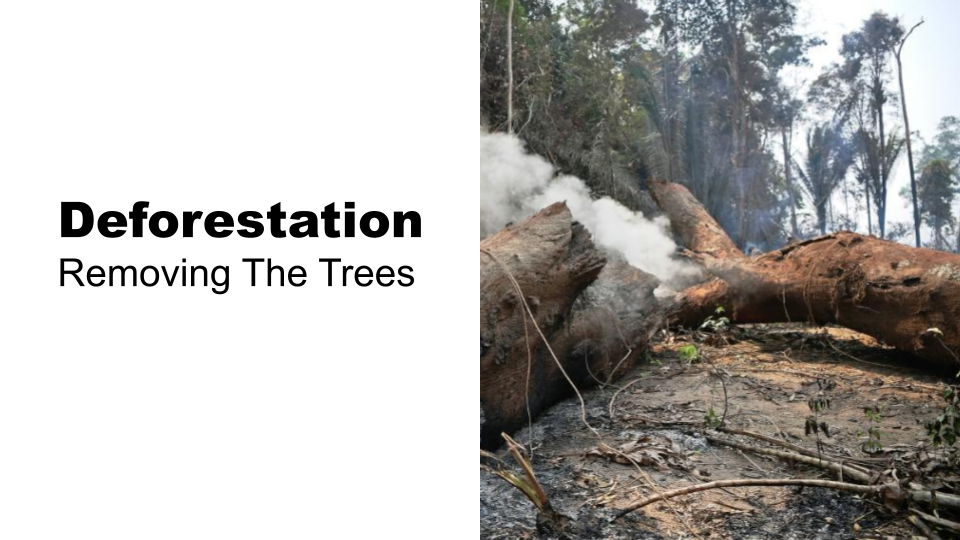
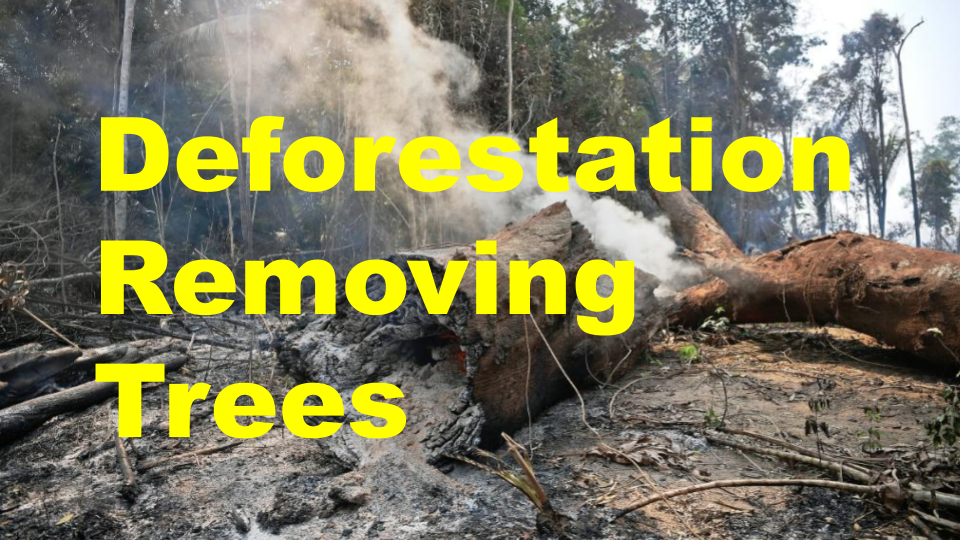
5min Deforestation Presentation Slideshow Instructions.
Slide 1: Title & Your Name
Slide 2-3: Benefits of Trees
Slide 4: Define Deforestation (look it up.)
Slide 5: Where is deforestation happening?
Slide 6-7: Why is deforestation happening? (NUMBERS and it isn't because we want the trees.)
Slide 8: How much land is being used for meat? How is this inefficient use of our resources?
Slide 9: More facts. (NUMBERS)
Slide 10-11: How can people help prevent deforestation and why does it matter?
15-20min Deforestation Presentation Slideshow Completions. Students research deforestation using the provided video resources then complete the slideshow.
5min Collect materials. Clean up. Wrap up.
Photosynthesis & Cellular Respiration: Basics Review 2
HW: [1] Make Flashcards. [2] Review your notes and videos.
CW: Complete Think & Explain Photosynth. & CR #3 Handout.
DN: Take handouts and start answering.
Reminders: [1] Work on your projects. Plastic must be at least two layers thick and fused together. Make sure to glue cardboard with grain going perpendicular to the previous layer of cardboard. [2] Retakes on last quiz, this Wednesday at lunch. Must have attended a lunch review before taking the retake.
QUICK VIEW
HW: [1] Make Flashcards. [2] Review your notes and videos.
CW: Complete Think & Explain Photosynth. & CR #3 Handout.
DN: Take handout and start answering.
Reminders: [1] Work on your projects. Plastic must be at least two layers thick and fused together. Make sure to glue cardboard with grain going perpendicular to the previous layer of cardboard. [2] Retakes on last quiz, this Wednesday at lunch. Must have attended a lunch review before taking the retake.
RESOURCES
LESSON OUTLINE
5min< Students complete the Do Now by starting to fill in worksheet.
20min Think & Explain Photosynth. & CR #3. Students complete the worksheet. Class goes over the answers.
10min INGO. Photosynthesis, Mitochondria, H2O, Cellulose, Air, Chloroplast, CO2, Sugar, Starch, Plants, Food, Move/Grow/Think/Repair, O2, Energy [ATP], Energy [Light], and Animals.
5min Students turn INGO sheet into flashcards.
5min Collect materials. Clean up. Wrap up.
Chemistry: Atoms to Molecules (2 of 2)
HW: Start planning for your Atom Model project.
CW: Completed Atom, Bonds, & Molecules Handout
DN: Decode the message using the periodic table. Beryllium Potassium Iodine Neodymium
EQ: How do atoms connect to form molecules?
QUICK VIEW
HW: Start planning for your Atom Model project.
CW: Completed Atom, Bonds, & Molecules Handout
DN: Decode the message using the periodic table. Beryllium Potassium Iodine Neodymium
EQ: How do atoms connect to form molecules?
RESOURCES

Project: Atomic Structure Model
Atoms, Bonds, & Molecules Handout
Atoms Paper Models (Lewis Dot) - Not Available Online
LESSON OUTLINE
5min Students complete the Do Now by answering the questions in their notebooks.
10min Students cut out Lewis Dot structures for Oxygen, Nitrogen, Hydrogen, and Carbon.
25-30min Paper model molecules. Students create, one at a time, the following molecules: H2O, CH4, O2, N2, CH2O, N2H2, C2H2, and CO2. Teacher offers suggestions, hints, and tips. Students hold up finished molecules to compare structures.
5min Teacher demonstrates how to draw simplified molecule structures using their paper model molecules as reference.
5min Students draw the simplified structures for their molecules on the Atoms, Bonds, & Molecules Handout.
5min Students share their answers on the board and the classroom verifies.
5min Students draw the simplified structures for H2O2 and C2H6 without making a paper model first on the Atoms, Bonds, & Molecules Handout.
5min Students share their answers on the board and the classroom verifies.
10min Student complete the handout by answering the questions on the back.
5min Class goes over the answers.
5min Collect materials. Clean up. Wrap up.
AIM: Students will create models of molecules by bonding atoms together.
Chemistry: Visual Definitions
CW/HW: [1] Physical vs Chemical Changes MiniPoster [2] Formula Meaning MiniPoster.
DN: In a chemical reaction, how do you know there was a colour change?
EQ: What are the signs of a chemical reaction?
QUICK VIEW
CW/HW: [1] Physical vs Chemical Changes MiniPoster [2] Formula Meaning MiniPoster.
DN: In a chemical reaction, how do you know there was a colour change?
EQ: What are the signs of a chemical reaction?
LESSON OUTLINE
5min Students complete the Do Now.
15-20min Physical vs Chemical MiniPoster. Students pick 3 to Illustrate with color for each category. Divide the poster in half. Label the top of the left side ‘Physical Change’ and the right side ‘Chemical Change’ or ‘Chemical RXN.’ The less detail in your drawing the more labeling and explaining you will have to do.
Physical: (Same Atoms, Same Molecules) Melting, Freezing, Folding, Mixing, Sliced, Diced, Boiling.
Chemical: (Same Atoms, NEW Molecules) Signs include: Change in Smell, Formation of a Gas, Formation of a Solid, Change in Color, Change in Temp.
10min Formula Meaning MiniPoster. Students explain what the numbers mean in a formula as well as what not having a number means for H2O vs CH4 vs O2H2.
Example: H2O, The ‘H’ stands for Hydrogen, the ‘2’ means there are two Hydrogen, and the ‘O’ stands for only one Oxygen since there isn’t a number after.
5min Collect materials. Clean up. Wrap up.